
Three quotes for one renovation can come back at very different totals. They may describe the same room or home, but are they pricing the same work?
Price gaps can come from differences in scope, finishes, assumptions, allowances, or exclusions. Work left out of one proposal may need to be priced later as a change order, so compare what each company has agreed to build before comparing totals.
That matters most on major West Toronto projects: whole-home renovations, additions and second-storey additions, basement underpinning, and single-family-to-multi-unit conversions. This guide explains how to compare renovation quotes before choosing a contractor for a major project.
Step 1: Make Sure Everyone Bid the Same Project
Apples-to-apples only works if every contractor priced the same drawings, the same finishes, and the same assumptions about what is behind the walls.
One proposal may assume existing wiring or framing can stay, while another may flag those items for further assessment. Ask what each contractor checked and what remains unknown; a walkthrough cannot confirm every condition hidden inside an older home.
Hand every bidder the identical package before anyone prices anything: a scope document, a finish list, and any drawings you have. Then ask each one a simple question: “What did you assume about anything I did not specify?” Write the answers down. The assumptions are where the gap lives.
Step 2: Check What a Complete Quote Contains
For a major renovation, compare whether each proposal clearly includes or excludes:
- Demolition, disposal, and site protection (dust walls, floor protection, bin placement)
- Structural work and framing
- Plumbing, electrical, heating, and cooling
- Insulation, drywall, trim, paint
- Finishes and fixtures, with who supplies what
- Permit fees, drawings, engineering, and any required survey, clearly marked as included or excluded
- A start window and a realistic duration, plus what happens if the schedule slips
- A payment schedule tied to progress, not one giant deposit
- Warranty terms, and the name of who you call two years from now
- Final cleanup
- A written process for approving and pricing changes before extra work begins
- The total price and whether applicable taxes are included or shown separately
Look for a clear breakdown of the work, not necessarily a price for every screw. You need to see what each contractor has priced and where the scope differs.
For a major renovation, a one-page total is not detailed enough to compare. Ask for the written scope, assumptions, inclusions, exclusions, allowances, schedule, and payment terms.
If you are comparing proposals for a full-home project, see Ashford’s whole-home renovation services for the type of work the team takes on.
Step 3: Hunt for the Exclusions
The exclusions page is the most useful in any quote, and the one homeowners skim.
On older West Toronto homes, exclusions may involve knob-and-tube wiring, older water services, asbestos-containing materials, an undersized electrical panel, damaged joist ends, foundation waterproofing, or aging drain lines. These are conditions to ask about, not assume.
A quote that excludes an item is not automatically bad; it may be the contractor clearly identifying work they have not assessed or included. Ask how that condition will be investigated, approved, and priced if it is found.
A quote with no exclusions list deserves clarification. Make a two-column list for each proposal: included on one side, excluded or not yet assessed on the other. Repeated gaps may mean the scope needs more work before the prices are comparable.
Step 4: Price Out the Allowances Before You Sign
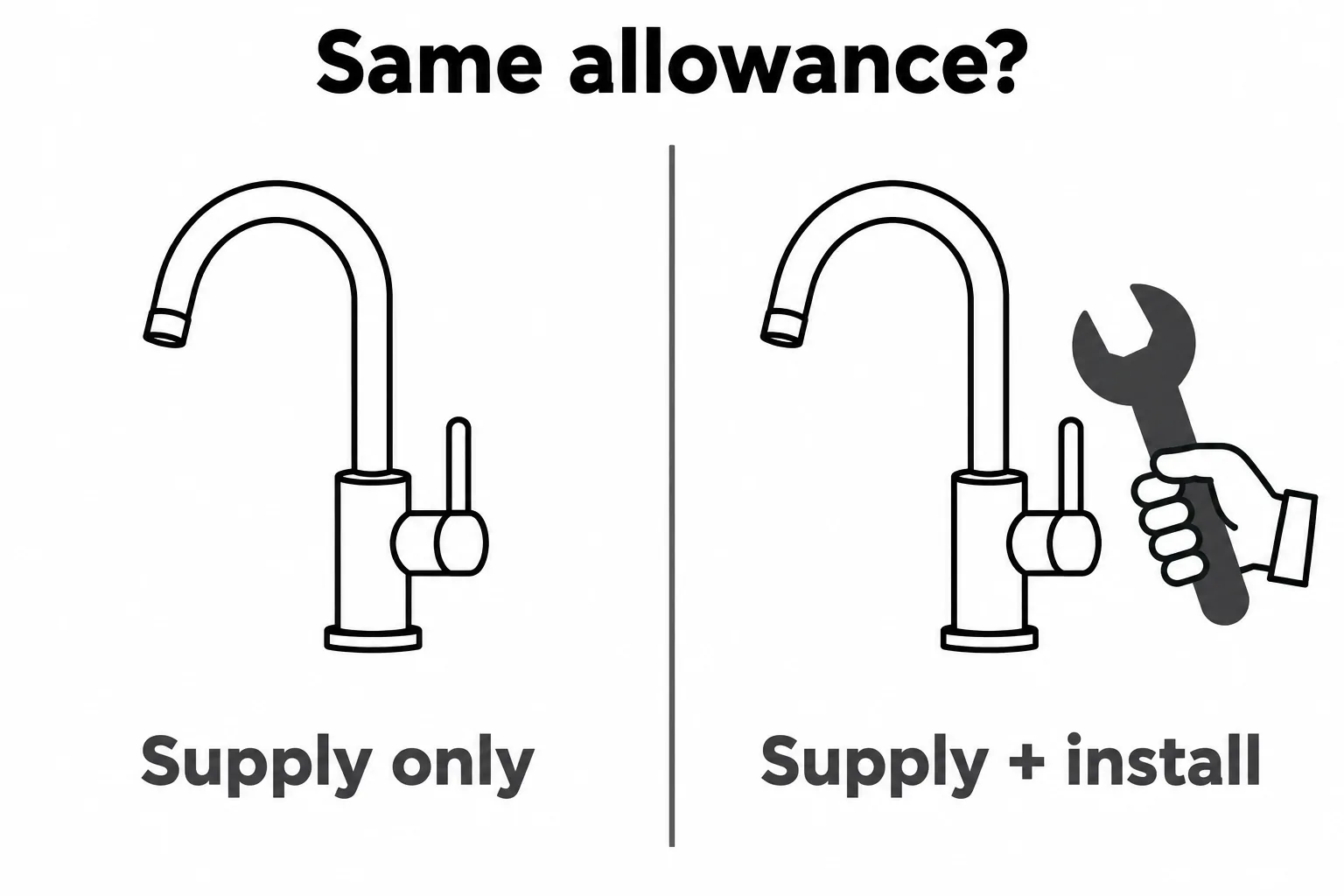
An allowance is usually a budget placeholder for an item you have not selected yet, such as tile, a faucet, or cabinetry. A provisional sum typically covers work whose scope or exact cost is not fully defined. Contract wording can vary, so ask what each amount covers and how the final cost will be adjusted.
Different allowances can make quotes look farther apart, or closer together, than the eventual costs will be. Compare the amount, the product or finish level it assumes, and whether the price covers supply only or supply and installation.
Choose a representative product or finish you would genuinely consider and ask each contractor to price the same level. Also ask what happens if the final selection costs more or less than the allowance, and whether any unused amount is credited.
Step 5: Normalize the Quotes Side by Side
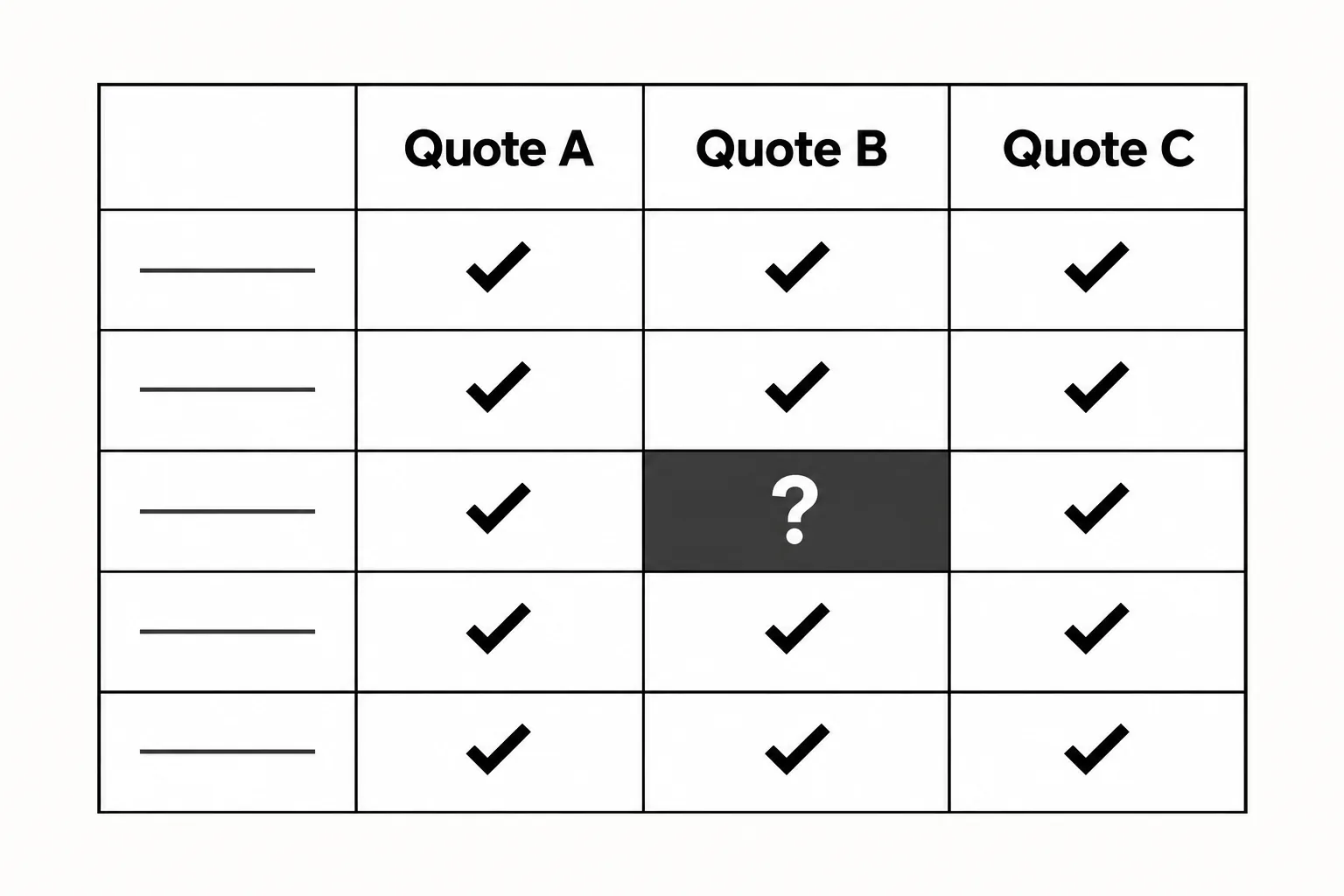
Here is the method for comparing two or three quotations fairly.
1. Build a table. One row per scope item, one column per contractor. 2. Fill it in. Every blank cell is a question, not an assumption. 3. Ask each contractor to price omitted work using the same written description and specification. Do not assume the higher quote’s number is automatically the correct price for the missing item. 4. Check the tax treatment. Confirm that each total either includes applicable tax or shows it separately, on the same basis. 5. Compare the payment schedules as part of the deal, not as fine print. Ask how any statutory holdback requirements affect the payment schedule.
Compare the totals only after the scope, assumptions, allowances, and tax treatment line up.
Ontario Estimates, Contracts and Holdback
Ontario recommends getting at least three written estimates. Home renovation contracts worth more than $50 must be in writing. If an estimate is included in the contract, Ontario guidance says the final price for the listed goods and services generally cannot exceed it by more than 10% unless you agree to additional or different work or a new price and sign a contract change. Read Ontario’s home renovation estimate and contract guidance and make sure the written agreement matches the work you expect.
A statutory holdback is a separate legal requirement, not simply a checklist item that proves a quote is complete. Ontario’s Construction Act sets a basic 10% holdback for contracts where a lien may arise. Ask how the current holdback and release rules apply to your project and payment schedule; the Ontario Construction Act is the official source.
A Simple Renovation Quote Comparison Table
Use this blank worksheet to compare the same work across proposals. “Included,” “excluded,” and “unclear” are prompts for your own quotes, not sample Ashford or contractor pricing.
Related readingHow to Choose a Renovation Contractor in TorontoRead the guide →| Scope item | Quote A | Quote B | Question to resolve |
|---|---|---|---|
| Drawings and project scope | Included/excluded / unclear | Included/excluded / unclear | Are both contractors pricing the same plans and rooms? |
| Demolition, disposal, and site protection | Included/excluded / unclear | Included/excluded / unclear | Who protects the home and removes debris? |
| Structural and mechanical work | Included/excluded / unclear | Included/excluded / unclear | What has been assessed, and what remains unknown? |
| Permits, drawings, engineering and fees | Included/excluded / unclear | Included/excluded / unclear | Who prepares, submits and pays for each item? |
| Allowances and provisional sums | Amount and basis / not stated | Amount and basis / not stated | What does the amount cover, and how is it adjusted? |
| Schedule, payment and changes | Stated / unclear / not stated | Stated / unclear / not stated | When are payments due, and how are changes approved? |
Step 6: Compare Project Management, Communication and Change Orders
A quote also shows how responsibilities and communication may be handled once work begins.
Pay attention to who owns what. Who prepares the permit drawings? Who submits the application and answers the city’s comments? Does design sit with one company and construction with another, and if so, who is responsible when the drawings and the price do not match?
When one team coordinates design, permits, and construction, there may be fewer handoffs to manage. Ask which services the proposal covers, who handles permit questions, and when the price and timeline are confirmed. Ashford’s renovation process moves from consultation and planning to a detailed proposal with scope, timeline, and pricing.
Ask how change orders are priced and approved, and whether you will see them in writing before work begins. Also ask how you will receive updates. Ashford clients use JobTread to follow the project and communicate with the team.
Red Flags to Clarify Before Signing
- Pressure to sign immediately or pay an unusually large amount up front. If you sign a qualifying renovation agreement at home, Ontario’s contract cancellation guidance explains when a 10-day cooling-off period may apply. Check the rules for your agreement before signing.
- A cash discount offered for skipping tax or paperwork. Ask for a written scope, contract, and receipt, with taxes stated clearly. An off-the-books offer can leave you with incomplete records and may complicate a later dispute.
- No permit in the scope of work that obviously needs one, or a suggestion to build now and deal with the city later.
- Verbal promises that never appear in the written quote. If it is not written, it is not priced.
- No proof of current liability insurance, or no explanation of applicable WSIB coverage. Ask for the appropriate clearance or proof of exemption and check it through WSIB’s clearance guidance.
- A timeline dramatically shorter than everyone else’s, with no explanation of how.
- Ask for references or relevant portfolio examples that the company has permission to share.
Toronto Permits, Zoning and Older Homes: What to Check
For a West Toronto project, compare how each proposal handles permits, zoning checks, and conditions that may be uncovered in an older home.
The City of Toronto requires permits for additions and certain structural or material alterations, including moving walls. Its guide also lists basement underpinning and adding a second suite among work that requires a permit. Check the details for your plans in the City’s building permit guidance.
Ask whether the price includes permit drawings, application fees, required engineering, and any survey, or only construction. Ask who prepares the drawings, submits the application, and responds to City comments. Ashford is BCIN licensed and handles design and permit applications in-house.
Zoning rules affect what can be built and where it can sit on a lot. If a proposal does not fit the rules, ask whether it needs redesign or a minor variance application to Toronto’s Committee of Adjustment. Clarify who prepares and manages that application and how its timing and fees affect the project.
Then ask the harder questions. On a semi-detached or row house, how does the scope handle the party wall and neighbour coordination? What happens if an inspection identifies work that needs correction, and how will that be priced? Clear answers before work is scheduled can reduce avoidable uncertainty later.
How to Ask About a Higher Quote
Instead of opening with “you’re too expensive,” ask the contractor to explain the difference between the proposals.
Share a specific scope gap, not the other company’s total. For example: “Your quote includes an electrical service upgrade and the other one doesn’t. Can you explain what each proposal assumes?” That keeps the conversation about work rather than just the price.
Then ask what could be removed, phased, or simplified to meet your budget, and what the contractor would not recommend cutting. Keep code, structural safety, and the durability of the work in view when comparing possible reductions.
If a contractor makes a large price reduction without changing the written scope, ask what changed in the assumptions, allowances, schedule, or price. Get the revised proposal in writing so you can compare the same work.
If the Quotes Exceed Your Budget
If every proposal is above budget, ask what can be phased, simplified, or removed without compromising code or structural requirements. Have each contractor reprice the same revised scope so you are still comparing equivalent work.
Phasing can be useful when the first stage is planned with later work in mind. For example, discuss whether a main-floor renovation now could affect a basement project or addition later, and ask how the sequence will be reflected in the scope and schedule.
A Short Checklist Before You Sign Anything
- Every contractor bid the same scope and the same finishes
- Inclusions cover demolition through final cleanup
- You have read the exclusions, not skimmed them
- You priced a real product against each allowance
- Start window, duration, and slip handling are in writing
- Payments are tied to progress, not front-loaded
- Permits, drawings, and engineering are assigned to someone by name
- Warranty terms are written down
- Ask for references or relevant portfolio examples that the company has permission to share
One last question: which quote proved the company understood your house, not just your square footage?
Talk Through Your Quotes With Someone Local
If your quotes do not line up, use the comparison table above to list the differences and questions you still need answered. A free consultation is a chance to discuss your West Toronto project, its scope, permits, and timing.
We have 25 years and more than 100 homes in the west end behind us, and we live in the same neighbourhoods we build in. Design, permits, and construction sit with one team; the price and timeline are clear before work starts, and the work is backed by a 5-year warranty we honour.
Design and permit work can take months before construction begins, so start the conversation well before your preferred build date. Book a free consultation and discuss your project with our team.
